
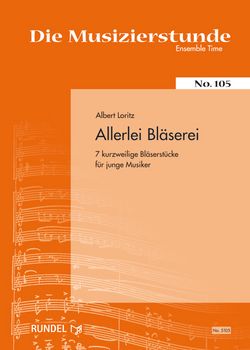
Albert Loritz
All kinds of brass
Ensemble Time 105
Ver
PDF
Albert Loritz
All kinds of brass
Ensemble Time 105
- Formación Cuarteto de viento
- Formación optativa 4 instrumentos de viento y instrumentos de percusión
- Compositor Albert Loritz
- Serie Die Musizierstunde
-
Dificultad
- Edición Partitura de dirección y set de partichelas
- Editorial Musikverlag Rundel
- Nº de pedido MVSR5105
 disponible en 2-5 días laborables
IVA incluido.,
Más gastos de envío
No disponible en todos los países. Leer más

Descripción de la:
1st voice in C (high)
1st voice in Bb
1st voice in Eb
2nd voice in Bb
2nd voice in Eb
3rd voice in C
3rd voice in Bb
3rd voice in F
3rd voice in Eb
4th voice in C
4th voice in Bb
4th voice in C (low)
4th voice in Eb (low)
Percussion ad. lib.
These wind pieces are intended as practice and performance pieces for young wind players who have already progressed a bit in individual lessons and should now practice playing together and gain their first orchestral experience.
Our collection combines pieces of varying difficulty and character; the sometimes amusing titling and the varied quartet setting, in which all individual voices have interesting tasks, should help to spark the young wind players' enthusiasm for playing.
About the instrumentation:
The limited range of the individual voices and the rich part equipment of this collection with C, B-flat, F and E-flat voices allow countless instrumentation variations. Depending on the size and composition of the playing groups, delightful instrumental combinations can be formed, from quartets to colorfully orchestrated small youth wind orchestras. Please make sure that all voices are as equally strong as possible.
As experience shows that the distribution of the high voices does not cause any problems (flutes, clarinets, trumpets are always available in sufficient numbers), greater attention should be paid to the instrumentation of the lower voices. For example, the alto saxophones in the orchestra should not play the melody (as in the saxophone quartet), but the 2nd voice. The trombones should be used at first on the 4th voice, and only when the instrumentation is more lush can a player also blow the tenor part.
On Interpretation:
Instructions on articulation and dynamics have been made comparatively sparingly in the musical text. Young wind players may learn to work out for themselves, in cooperation with their instrumental teacher and the conductor, the style of playing appropriate to the character of a particular piece.
The performance of our seven pieces can be given greater variety by changing instrumental groups (in larger ensembles) for certain sections, or by leaving certain instruments silent: Wood/Brass; +Trumpet/-Trumpet;+Tuba/-Tuba; +Flutes/-Flutes. Particularly often (e.g., in the forte-piano change in repetitions), it will be useful to alternate trumpets and clarinets when playing the 1st and 2nd voices. The 3rd and 4th voices, which are likely to be sparser most of the time, can remain in use throughout.
The percussion is basically ad libitum. Since it merely underscores the rhythmic structures already evident in the individual pieces in the quartet movement, its part was also quite deliberately not included in the directional part; only the use or silence of the percussion instruments was noted in the appropriate places. In accordance with the different character of the individual pieces, the selection of the percussion instruments to be used in each case can be arranged individually according to the available possibilities and the imagination of the conductor. But remember that the percussion can also be silent for a longer section (e.g. during repetitions) or for a whole piece!
Have fun making music.
Albert Loritz
1st voice in Bb
1st voice in Eb
2nd voice in Bb
2nd voice in Eb
3rd voice in C
3rd voice in Bb
3rd voice in F
3rd voice in Eb
4th voice in C
4th voice in Bb
4th voice in C (low)
4th voice in Eb (low)
Percussion ad. lib.
These wind pieces are intended as practice and performance pieces for young wind players who have already progressed a bit in individual lessons and should now practice playing together and gain their first orchestral experience.
Our collection combines pieces of varying difficulty and character; the sometimes amusing titling and the varied quartet setting, in which all individual voices have interesting tasks, should help to spark the young wind players' enthusiasm for playing.
About the instrumentation:
The limited range of the individual voices and the rich part equipment of this collection with C, B-flat, F and E-flat voices allow countless instrumentation variations. Depending on the size and composition of the playing groups, delightful instrumental combinations can be formed, from quartets to colorfully orchestrated small youth wind orchestras. Please make sure that all voices are as equally strong as possible.
As experience shows that the distribution of the high voices does not cause any problems (flutes, clarinets, trumpets are always available in sufficient numbers), greater attention should be paid to the instrumentation of the lower voices. For example, the alto saxophones in the orchestra should not play the melody (as in the saxophone quartet), but the 2nd voice. The trombones should be used at first on the 4th voice, and only when the instrumentation is more lush can a player also blow the tenor part.
On Interpretation:
Instructions on articulation and dynamics have been made comparatively sparingly in the musical text. Young wind players may learn to work out for themselves, in cooperation with their instrumental teacher and the conductor, the style of playing appropriate to the character of a particular piece.
The performance of our seven pieces can be given greater variety by changing instrumental groups (in larger ensembles) for certain sections, or by leaving certain instruments silent: Wood/Brass; +Trumpet/-Trumpet;+Tuba/-Tuba; +Flutes/-Flutes. Particularly often (e.g., in the forte-piano change in repetitions), it will be useful to alternate trumpets and clarinets when playing the 1st and 2nd voices. The 3rd and 4th voices, which are likely to be sparser most of the time, can remain in use throughout.
The percussion is basically ad libitum. Since it merely underscores the rhythmic structures already evident in the individual pieces in the quartet movement, its part was also quite deliberately not included in the directional part; only the use or silence of the percussion instruments was noted in the appropriate places. In accordance with the different character of the individual pieces, the selection of the percussion instruments to be used in each case can be arranged individually according to the available possibilities and the imagination of the conductor. But remember that the percussion can also be silent for a longer section (e.g. during repetitions) or for a whole piece!
Have fun making music.
Albert Loritz