
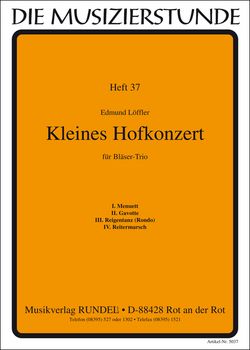
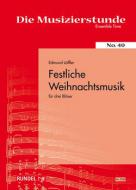
Edmund Löffler
Small court concert
Ensemble Time 37
Ver
PDF
Edmund Löffler
Small court concert
Ensemble Time 37
- Formación Trío de viento
- Compositor Edmund Löffler
- Serie Die Musizierstunde
-
Dificultad
- Edición Partitura general y partichelas
- Editorial Musikverlag Rundel
- Nº de pedido MVSR5037
 disponible en 2-5 días laborables
IVA incluido.,
Más gastos de envío
No disponible en todos los países. Leer más

Descripción de la:
In the memory of earlier musical epochs, the rococo era enjoys particular popularity. Involuntarily, one thinks of the radiant splendor of candlelit rooms, where elegantly dressed people moved gracefully on a mirrored parquet. This idea may also be the backdrop for this 'Little Court Concert'.
The first two pieces, Minuet and Gavotte, are dances as they were once performed with graceful movements and polite bows. Musically they find their expression by means of appropriate accents. It is similar in the third piece, in the Reigentanz, which requires a lot of swing.
The Chevalersque in the Rider's March, the conclusion of the 'Court Concerto', is achieved with sharp emphasis, restrained tempo and pointed staccato. Like most equestrian marches of the time, the trio has solemn expression; originally probably a symbol that to be a soldier meant for the horsemen not only to sit in particularly splendid uniform on proud steeds, but that in the background there was also always hidden the bitter seriousness.
Contents:
1. Minuet
2. Gavotte
3. Round Dance (Rondo)
4. Equestrian March
This edition contains the following parts:
1. Part in Bb (flugelhorn/trumpet/clarinet)
2nd part in Bb (flugelhorn/trumpet/clarinet)
3rd part in Bb (tenor horn, baritone, trombone, tenor saxophone, bass clarinet)
1st part in C (flute)
1. Voice in Eb (Eb clarinet, Eb alto saxophone)
2. Voice in Bb (clarinet/tenor saxophone)
2. Voice in Eb (alto saxophone, horn)
2. Voice in F (horn)
3. Voice in Eb (baritone saxophone)
3. Voice in C (baritone, trombone, bassoon)
The first two pieces, Minuet and Gavotte, are dances as they were once performed with graceful movements and polite bows. Musically they find their expression by means of appropriate accents. It is similar in the third piece, in the Reigentanz, which requires a lot of swing.
The Chevalersque in the Rider's March, the conclusion of the 'Court Concerto', is achieved with sharp emphasis, restrained tempo and pointed staccato. Like most equestrian marches of the time, the trio has solemn expression; originally probably a symbol that to be a soldier meant for the horsemen not only to sit in particularly splendid uniform on proud steeds, but that in the background there was also always hidden the bitter seriousness.
Contents:
1. Minuet
2. Gavotte
3. Round Dance (Rondo)
4. Equestrian March
This edition contains the following parts:
1. Part in Bb (flugelhorn/trumpet/clarinet)
2nd part in Bb (flugelhorn/trumpet/clarinet)
3rd part in Bb (tenor horn, baritone, trombone, tenor saxophone, bass clarinet)
1st part in C (flute)
1. Voice in Eb (Eb clarinet, Eb alto saxophone)
2. Voice in Bb (clarinet/tenor saxophone)
2. Voice in Eb (alto saxophone, horn)
2. Voice in F (horn)
3. Voice in Eb (baritone saxophone)
3. Voice in C (baritone, trombone, bassoon)
-
Menuett
-
Gavotte
-
Reigentanz (Rondo)
-
Reitermarsch
Los clientes han valorado este artículo:
Información del Fabricante:
Musikverlag Rundel
Untere Gewendhalde 27
88430
Rot an der Rot
Deutschland
Otros clientes también compraron:
- Trío de viento
- Partitura general y partichelas
-
disponible en 2-5 días laborables
Spielliteratur für Bläser
- Trío de viento
- Partituras
- Herbert Frei
-
disponible en 4-8 días laborables
- Cuarteto de clarinetes
- Partitura general y partichelas
- Jirka Kadlec
-
disponible en 1-2 semanas
- También disponible para descarga.
Spielliteratur für Bläser
- Trío de viento
- Partituras
- Herbert Frei
-
en stock
disponible en 1-3 días laborables
James Rae
- Clarinete
- Partituras
-
en stock
disponible en 1-3 días laborables
- Trío de viento
- Partitura general y partichelas
-
disponible en 2-5 días laborables
Beach Boys
Flexible instrumentation for brass, woodwinds or strings - Includes percussion
- Orquesta de viento (instrumentación flexible: 5 instrumentos y percusión)
- Partitura general, repuestos y vídeo en línea
- Michael Brown
-
en stock
disponible en 1-3 días laborables - También disponible para descarga.
Neil Diamond
- Orquesta de viento
- Partitura general y partichelas
- Stefan Schwalgin
-
en stock
disponible en 1-3 días laborables
Queen
- Orquesta de viento
- Partitura general y partichelas
- Paul Murtha
-
en stock
disponible en 1-3 días laborables - También disponible para descarga.
The Beatles
- Orquesta de viento
- Partitura general y partichelas
- Johnnie Vinson
-
disponible en 3-6 días laborables
- También disponible para descarga.
- Trío de viento
- Partitura general y partichelas
-
en stock
disponible en 1-3 días laborables


- Trío de viento
- Partitura general y partichelas
- Eric J. Hovi
-
en stock
disponible en 1-3 días laborables
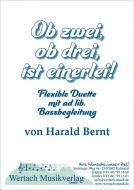
Harald Bernt
11 Flexible Duette mit ad lib. Bassbegleitung
- 2-3 instrumentos de viento
- Partitura de dirección
-
disponible en 2-5 días laborables