
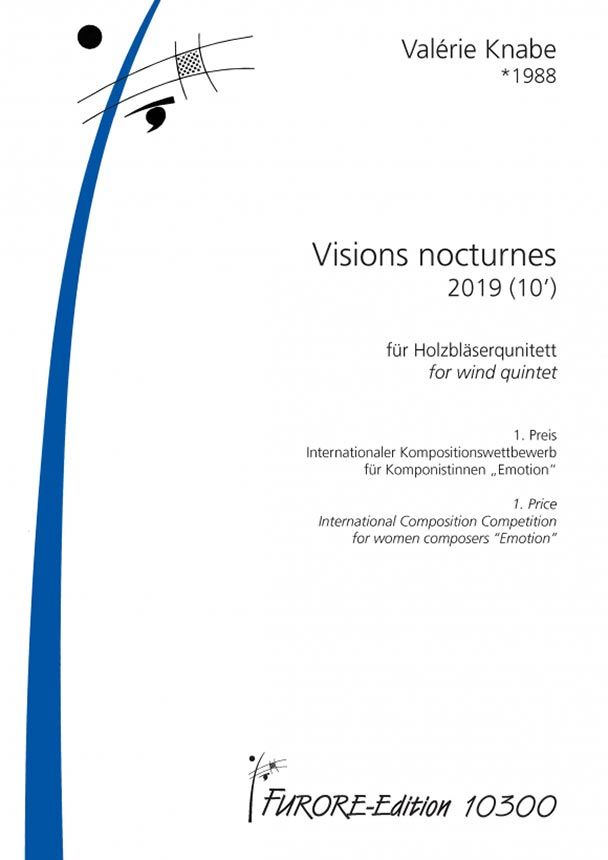
Valérie Knabe
Visions nocturnes
for wind quintet
Valérie Knabe
Visions nocturnes
for wind quintet
- Formación Quinteto de viento (flauta travesera, oboe, clarinete, trompa y fagot)
- Compositor Valérie Knabe
-
Dificultad
- Edición Partituras
- Editorial Furore Verlag
- Nº de pedido FUR10300
 disponible en 4-8 días laborables
IVA incluido.,
Más gastos de envío
No disponible en todos los países. Leer más

Descripción de la:
1st prize in the international composition competition for women composers 'Emotion'
Visions nocturnes, a 10-minute work for classical wind quintet, was composed by Valérie Knabe in 2019 for the international composition competition 'Emotion' and
was awarded 1st prize. The competition was announced by the Förderverein Archiv Frau und Musik Kassel and the Bundeswehr Center for Military Music with the aim
of expanding the standard repertoire for wind quintets to include works by female composers. The title of the piece suggests a mysterious and sombre mood. The atmosphere, evoking the mysterious uncertainty of the night, is conveyed through the use of varying soundscapes. These are sometimes calm and contemplative, sometimes rather more dynamic and hectic.
'With the composition of Visions nocturnes (nocturnal visions) a memorable composition was created, inspired by the keyword 'Emotion'. A short introduction by
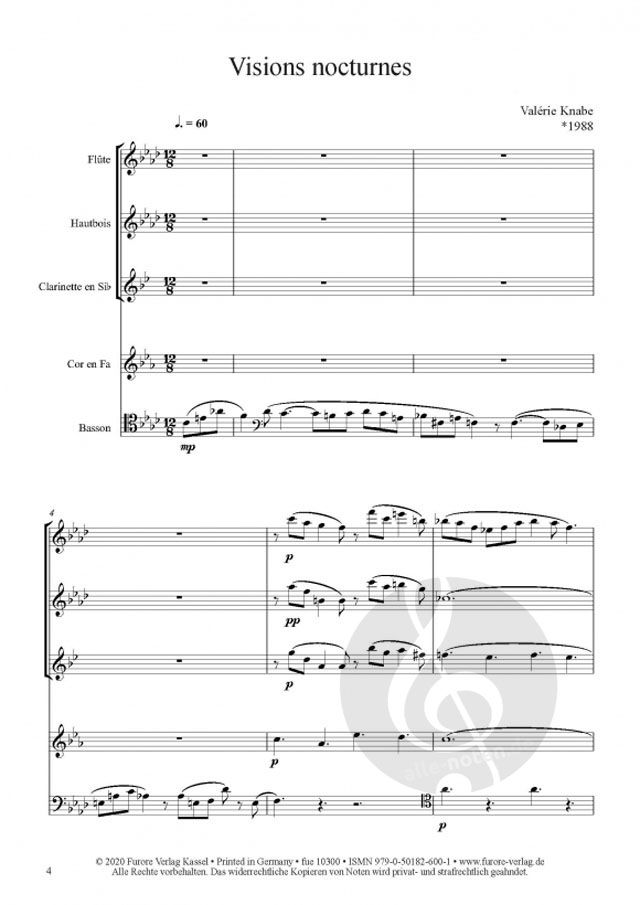
the bassoon sets the scene, leading to a ray of light when the other instruments enter together a few bars later.. The homophonic development of the high woodwinds, while the bassoon retains a more solistic, independent role, is an interesting compositional
device. In the course of the work, all instruments develop an individuality, becoming more 'emotional', letting go of the original idea of 'nocturnal visions' and also introducing an element of joy. The almost playful use of dynamics underlines the artistic quality of this work, which concludes with a dramatical finale. It unreservedly deserves first place in the competition.' (The jury)
Visions nocturnes, a 10-minute work for classical wind quintet, was composed by Valérie Knabe in 2019 for the international composition competition 'Emotion' and
was awarded 1st prize. The competition was announced by the Förderverein Archiv Frau und Musik Kassel and the Bundeswehr Center for Military Music with the aim
of expanding the standard repertoire for wind quintets to include works by female composers. The title of the piece suggests a mysterious and sombre mood. The atmosphere, evoking the mysterious uncertainty of the night, is conveyed through the use of varying soundscapes. These are sometimes calm and contemplative, sometimes rather more dynamic and hectic.
'With the composition of Visions nocturnes (nocturnal visions) a memorable composition was created, inspired by the keyword 'Emotion'. A short introduction by
the bassoon sets the scene, leading to a ray of light when the other instruments enter together a few bars later.. The homophonic development of the high woodwinds, while the bassoon retains a more solistic, independent role, is an interesting compositional
device. In the course of the work, all instruments develop an individuality, becoming more 'emotional', letting go of the original idea of 'nocturnal visions' and also introducing an element of joy. The almost playful use of dynamics underlines the artistic quality of this work, which concludes with a dramatical finale. It unreservedly deserves first place in the competition.' (The jury)