
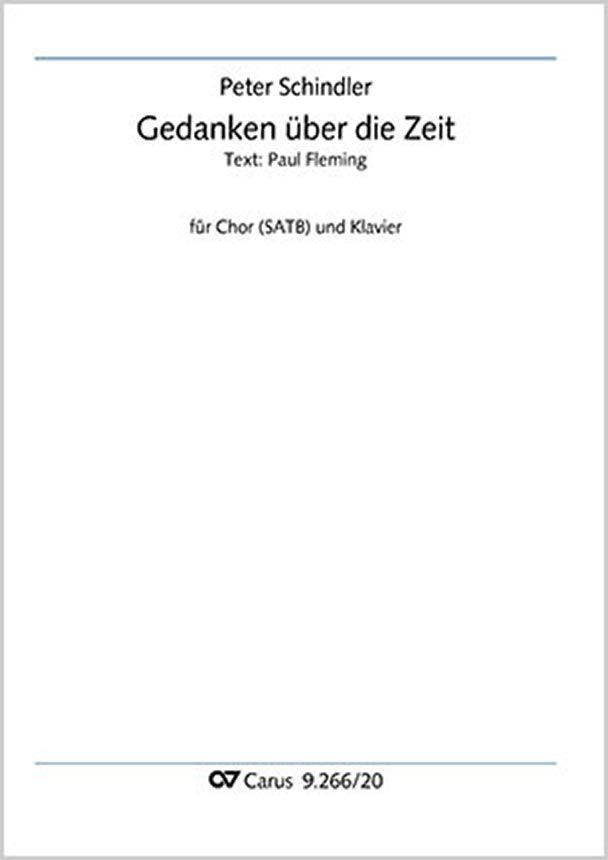
Peter Schindler
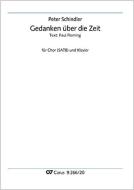
Gedanken über die Zeit
aus: Sonne, Mond und Sterne
Escuchar
demo
Ver
PDF
Peter Schindler
Gedanken über die Zeit
aus: Sonne, Mond und Sterne
- Formación Coro mixto (SATB) y piano
- Compositor Peter Schindler
-
Dificultad
- Edición Partitura de piano
- Editorial Carus-Verlag
- Nº de pedido CV09266-20
 disponible en 2-5 días laborables
IVA incluido.,
Más gastos de envío
- Escala de cantidades:
- desde 40 Unidades 3,78 €
- desde 60 Unidades 3,36 €
No disponible en todos los países. Leer más
Descripción de la:
Peter Schindler's full-length secular choral work Sonne, Mond und Sterne (Sun, Moon and Stars) narrates a love story based on 'old' texts which are given a new interpretation through these musical settings. Some individual numbers were published in spring, and now more movements with piano accompaniment are available in print and digitally.
choral work of medium difficulty
will appeal to experienced Brahms Requiem singers as well as ambitious chamber or youth choirs with a gospel, pop or jazz background
cross-over between jazz, chanson, and chamber music
Peter Schindler about Gedanken über die Zeit:
Paul Fleming was one of the most important lyric poets in German Baroque literature. He wrote his poem Gedanken über die Zeit in his early twenties; it was first published in 1634 as an epitaph. All the nuances of the concept of time are artistically contrasted, and the motif 'Zeit' (time) is explored and played with in a dialectical manner.
The male voices begin in unison at an andante maestoso tempo, followed by a leisurely progress in homophonic writing in a slightly freer rhythm. A lively middle section follows which leads into the opening motif again in the last section. The third section contains a fugue, and the end is unison once again. And so the words are like a manifesto by the poet.
choral work of medium difficulty
will appeal to experienced Brahms Requiem singers as well as ambitious chamber or youth choirs with a gospel, pop or jazz background
cross-over between jazz, chanson, and chamber music
Peter Schindler about Gedanken über die Zeit:
Paul Fleming was one of the most important lyric poets in German Baroque literature. He wrote his poem Gedanken über die Zeit in his early twenties; it was first published in 1634 as an epitaph. All the nuances of the concept of time are artistically contrasted, and the motif 'Zeit' (time) is explored and played with in a dialectical manner.
The male voices begin in unison at an andante maestoso tempo, followed by a leisurely progress in homophonic writing in a slightly freer rhythm. A lively middle section follows which leads into the opening motif again in the last section. The third section contains a fugue, and the end is unison once again. And so the words are like a manifesto by the poet.
Los clientes han valorado este artículo:
Información del Fabricante:
Carus-Verlag GmbH & Co. KG
Sielminger Str. 51
70771
Leinfelden-Echterdingen
Deutschland
Artículos relacionados:

- Voz (media) y piano
- Partitura de piano para descargar
- Carus-Verlag
-
-
Inmediatamente disponible
Descargar inmediatamente al finalizar la orden - Descarga instantánea
- Voz (media) y piano
- Partitura de piano
- Carus-Verlag
-
-
disponible en 2-5 días laborables
- También disponible para descarga.
- Coro mixto (SATB) y piano
- Partitura de piano para descargar
- Carus-Verlag
-
-
Inmediatamente disponible
Descargar inmediatamente al finalizar la orden - Descarga instantánea
- Coro mixto (SATB) y piano
- Partitura de piano para descargar
- Carus-Verlag
-
-
Inmediatamente disponible
Descargar inmediatamente al finalizar la orden - Descarga instantánea
- Voz (media), coro mixto (SATB) y piano
- Partitura de piano
- Carus-Verlag
-
-
disponible en 2-5 días laborables
- También disponible para descarga.
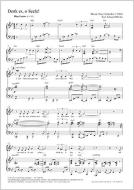
- Coro mixto (SATB) y piano
- Partitura de piano para descargar
- Carus-Verlag
-
-
Inmediatamente disponible
Descargar inmediatamente al finalizar la orden - Descarga instantánea
- Coro mixto (SATB) y piano
- Partitura de piano
- Carus-Verlag
-
-
disponible en 2-5 días laborables
- También disponible para descarga.
- Coro mixto (SATB) y piano
- Partitura de piano
- Carus-Verlag
-
-
disponible en 2-5 días laborables
- También disponible para descarga.
- Coro mixto (SATB) y piano
- Partitura de piano para descargar
- Carus-Verlag
-
-
Inmediatamente disponible
Descargar inmediatamente al finalizar la orden - Descarga instantánea
- Coro mixto (SATB) y piano
- Partitura de piano
- Carus-Verlag
-
-
disponible en 2-5 días laborables
- También disponible para descarga.
- Voz (media), coro mixto (SATB) y piano
- Partitura de piano para descargar
- Carus-Verlag
-
-
Inmediatamente disponible
Descargar inmediatamente al finalizar la orden - Descarga instantánea
- Voz (media), coro mixto (SATB) y piano
- Partitura de piano
- Carus-Verlag
-
-
disponible en 2-5 días laborables
- También disponible para descarga.
- Coro mixto (SATB) y piano
- Partitura de piano
- Carus-Verlag
-
-
disponible en 2-5 días laborables
- También disponible para descarga.
- Coro mixto (SATB) y piano
- Partitura de piano para descargar
- Carus-Verlag
-
-
Inmediatamente disponible
Descargar inmediatamente al finalizar la orden - Descarga instantánea
- Coro mixto (SATB) y piano
- Partitura de piano para descargar
- Carus-Verlag
-
-
Inmediatamente disponible
Descargar inmediatamente al finalizar la orden - Descarga instantánea
- Coro mixto (SATB) y piano
- Partitura de piano
- Carus-Verlag
-
-
disponible en 2-5 días laborables
- También disponible para descarga.
- Voz (media), coro mixto (SATB) y piano
- Partitura de piano para descargar
- Carus-Verlag
-
-
Inmediatamente disponible
Descargar inmediatamente al finalizar la orden - Descarga instantánea
- Coro mixto (SATB)
- Partitura general de coro
- Carus-Verlag
-
-
disponible en 2-5 días laborables
- También disponible para descarga.
- Coro mixto (SATB)
- Partitura general de coro para descargar
- Carus-Verlag
-
-
Inmediatamente disponible
Descargar inmediatamente al finalizar la orden - Descarga instantánea