
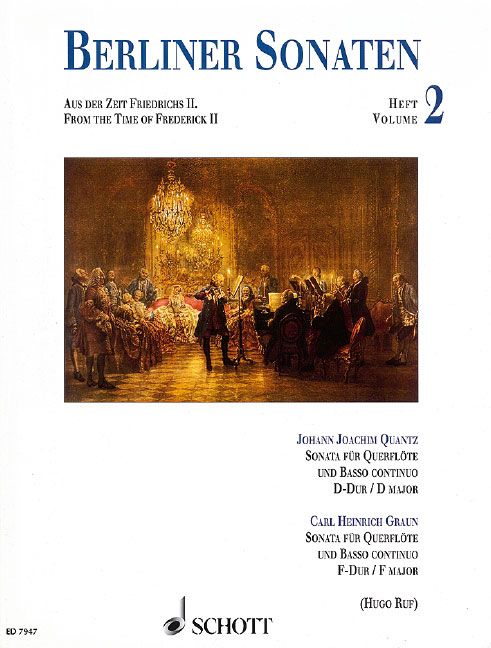
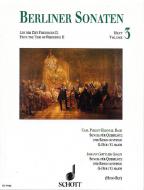
Berlin Sonatas Vol. 2
from the Time of Frederick II
Ver
PDF
Berlin Sonatas Vol. 2
from the Time of Frederick II
- Formación Flauta travesera y bajo continuo
- Adaptador Reinhard Matthias Ruf
- Editor Hugo Ruf
-
Dificultad
- Edición Partituras
- Editorial Schott Musik
- Nº de pedido ED7947
 en stock
disponible en 1-3 días laborables
IVA incluido.,
Más gastos de envío
No disponible en todos los países. Leer más

Descripción de la:
The 'Berlin Sonatas' for flauto traverso and basso continuo are compositions written during the reign of Frederick the Great. With the exception of the sonatas by Frederick II and his sister Anna Amalia, all of the works were penned by masters who had been in royal service for a longer period of time.
Johann Joachim Quantz, court composer, flute teacher and musical advisor to the king, writes in a section of his curriculum vitae, written in Potsdam in 1754, concerning musical life in Berlin after 1740: 'The royal music here in general; the sensible, mixed and delightful taste that reigns there....The good orchestra, which already from 1731 to 1740 stood in Ruppin and Reinsberg in a condition, which can excite every composer and concertist, and give him perfect satisfaction, which has been increased from the beginning of the present government to one of the most respectable in Europe, and the various outstanding virtuosos, who are in the same; all this, I say, has already made itself so well known and famous, that it would be an excess to describe each one according to its merits here in particular.'
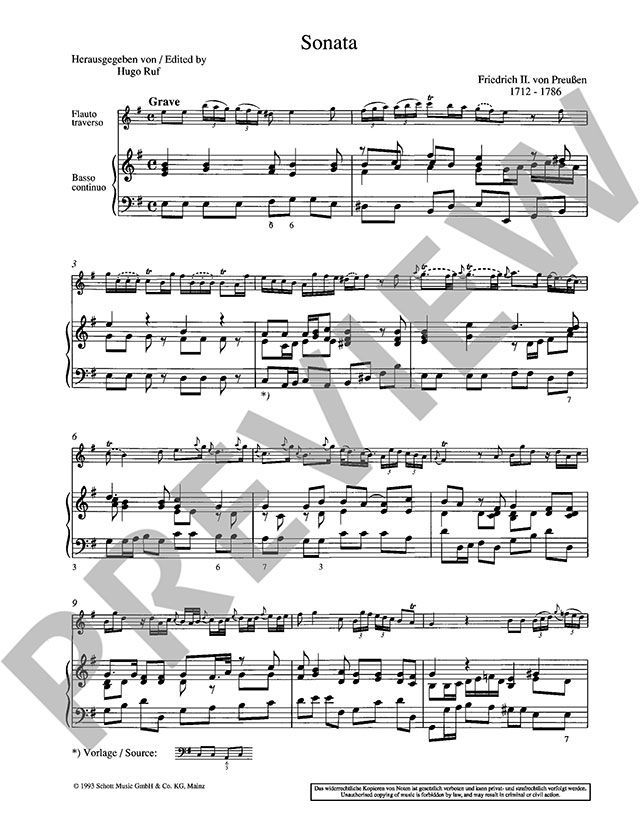
The sonatas appear in careful textual reproduction of the manuscripts and first prints that served as models for this edition.
Johann Joachim Quantz, court composer, flute teacher and musical advisor to the king, writes in a section of his curriculum vitae, written in Potsdam in 1754, concerning musical life in Berlin after 1740: 'The royal music here in general; the sensible, mixed and delightful taste that reigns there....The good orchestra, which already from 1731 to 1740 stood in Ruppin and Reinsberg in a condition, which can excite every composer and concertist, and give him perfect satisfaction, which has been increased from the beginning of the present government to one of the most respectable in Europe, and the various outstanding virtuosos, who are in the same; all this, I say, has already made itself so well known and famous, that it would be an excess to describe each one according to its merits here in particular.'
The sonatas appear in careful textual reproduction of the manuscripts and first prints that served as models for this edition.
-
Johann Joachim Quantz J.J. Quantz: Sonata D-Dur
-
Carl Heinrich Graun C.H. Graun: Sonata F-Dur
Los clientes han valorado este artículo:
Información del Fabricante:
Schott Music GmbH & Co. KG
Weihergarten 5
55116
Mainz
Deutschland
Artículos relacionados:
- Flauta travesera y bajo continuo
- Partituras
- Reinhard Matthias Ruf
- Schott Musik
-
-
en stock
disponible en 1-3 días laborables
- Flauta travesera y bajo continuo
- Partituras
- Reinhard Matthias Ruf
- Schott Musik
-
-
en stock
disponible en 1-3 días laborables
- Flauta travesera y bajo continuo
- Partituras
- Reinhard Matthias Ruf
- Schott Musik
-
-
en stock
disponible en 1-3 días laborables - También disponible para descarga.
- Flauta travesera y bajo continuo
- Partituras
- Reinhard Matthias Ruf
- Schott Musik
-
-
en stock
disponible en 1-3 días laborables