
Johann Sebastian Bach
Sonatas for Viola Da Gamba and Harpsichord
The Flute Collection (Henrik Wiese presents)

Ver
PDF
Recomendar
Recomendar artículo
Johann Sebastian Bach
Sonatas for Viola Da Gamba and Harpsichord
The Flute Collection (Henrik Wiese presents)
- Formación Flauta travesera y piano
- Formación optativa Violín y piano
- Edición Partituras
-
Dificultad
- Compositor Johann Sebastian Bach
- Adaptador Henrik Wiese
- Editorial Universal Edition
- Nº de pedido UE35578
IVA incluido.,
Más gastos de envío
 en stock
|
disponible en 1-3 días laborables

Descripción:
Arranging the three gamba sonatas BWV 1027 - 1029 for flute and obbligato harpsichord or piano may at first seem rather daring. The three-octave range of the viola da gamba (B - e flat2) that Bach used in these sonatas along with its low register are quite different from that of the baroque tranverse flute (d1 - e3). Yet Bach's Sonata for viola da gamba and obbligato harpsichord in G-major BWV 1027 links the gamba and flute literature. It also exists as a Trio Sonata for two flutes and basso continuo BWV 1039. The first flute part corresponds to the right hand of the harpsichord in the gamba sonata. The second flute part sounds an octave lower on the gamba. In the present edition all three gamba sonatas have been arranged for flute and obbligato harpsichord according to this historically documented principle of voice exchange and octave transposition. The only exception is the Adagio from the Sonata in g-minor BWV 1029. Here we dispensed with voice exchange so as to reduce the number of changes in the musical text. All three arrangements are intended for historical instruments. The ranges of the tranverse flute and of Bach's harpsichord have been strictly observed. Alternatives printed in small font are included for those passages where the modern Böhm flute allows one to play closer to the original. The limited range of the flute part means it is also suitable for performance on the oboe or violin. The present arrangement edition is based on historical sources for the gamba sonatas BWV 1027-1029 and the Trio Sonata for two flutes and basso continuo BWV 1039 1. For the arrangement of the Sonata BWV 1027/1039 the Trio Sonata version was preferred. Only in the third movement (Adagio) was the basso voice from the gamba sonata used so as to avoid the repetitions of the trio sonata that are less sonorous on the harpsichord. Errors and imperfections in the historical sources have been corrected without further comment. In the present edition we decided, however, against the consistent alignment of the performance markings and ornamentation between the flute and harpsichord parts or between parallel passages. The principal sources are all copies and it is totally unclear to what extent the performance markings and ornamentation they include can be traced back to Bach. Possible adjustments need not be additions - as is customary - but can also involve deletions or corrections. This means that there are many possible and equally valid solutions and such artistic decisions should be left to the performer. Henrik Wiese (Munich, August 2012) Finalist Newly Published Music Award of The National Flute Association (U.S.A)
-
Sonate in G-Dur BWV 1027/1039
-
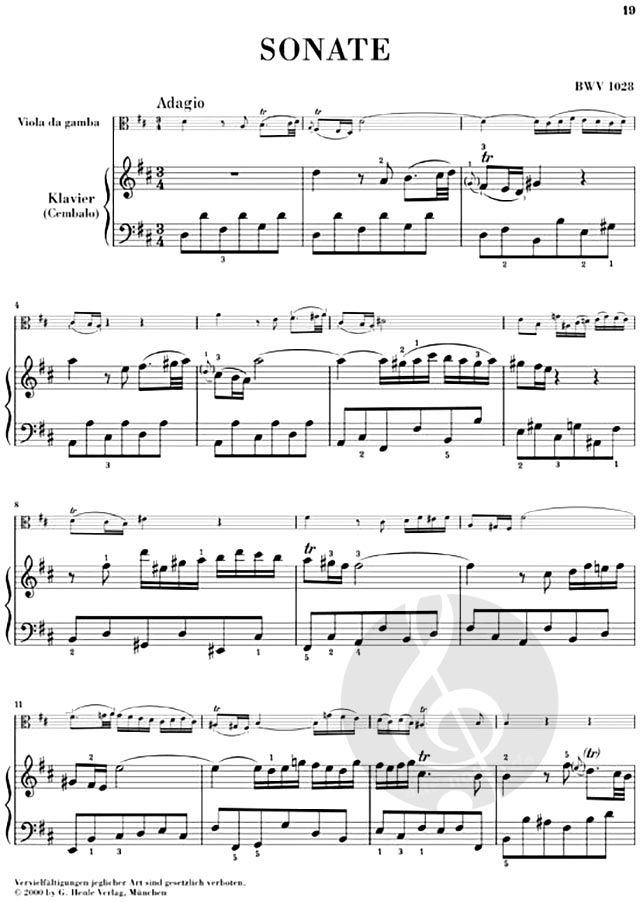
Sonate in D-Dur BWV 1028
-
Sonate in g-Moll BWV 1029
Los clientes han valorado este artículo:
Partituras desde 1969

Desde 1969, más de 500.000 clientes confían en nosotros. Con una enorme selección de más de 1.000.000 de partituras, somos uno de los mayores proveedores de Europa. Gracias a nuestro gran stock, a menudo podemos enviar partituras en 24 horas. Sea cual sea la partitura que busque: ¡está en el lugar correcto!
Atentamente, Stefanie Reichert
Responsable de atención al cliente

Otros clientes también compraron:

Johann Sebastian Bach
for Viola da Gamba and Harpsichord BWV 1027-1029 (Version for Viola da Gamba or Violoncello)
- Viola da gamba y clavicémbalo
- Partituras (Urtext)
-
en stock
|
disponible en 1-3 días laborables

- Flauta travesera y piano
- Partituras
- Henrik Wiese
-
disponible en 4-8 días laborables

Franz Danzi
- Flauta travesera y violonchelo
- Set de partichelas
-
en stock
|
disponible en 1-3 días laborables

- Dúo de flautas traveseras
- Partituras
- Peter Kolman
-
en stock
|
disponible en 1-3 días laborables

- 2 violines y piano
- Partitura de piano y partichela(s) (Urtext)
-
en stock
|
disponible en 1-3 días laborables

Johann Sebastian Bach
- Violín y clavicémbalo
- Partitura general (Urtext)
-
disponible en 2-4 días laborables

- Violín y piano
- Partituras (Urtext)
-
disponible en 2-5 días laborables