
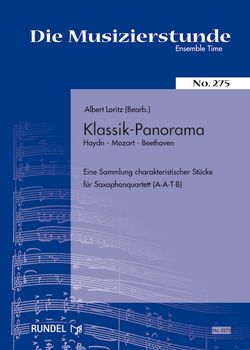
Classic Panorama
Ensemble Time 275
Ver
PDF
Classic Panorama
Ensemble Time 275
- Formación Cuarteto de saxofones (AATB)
- Adaptador Albert Loritz
- Serie Die Musizierstunde
-
Dificultad
- Edición Partitura general y partichelas
- Editorial Musikverlag Rundel
- Nº de pedido MVSR5275
 disponible en 2-5 días laborables
IVA incluido.,
Más gastos de envío
No disponible en todos los países. Leer más
Descripción de la:
1st alto saxophone in Eb
2nd alto saxophone in Eb
Tenor saxophone in Bb
Baritone saxophone in Eb
Literature recommendation for music school lessons
This is a collection of characteristic pieces for saxophone quartet, which focuses on the composers Haydn, Mozart and Beethoven. The booklet provides musically appealing, mostly moderately difficult pieces that can be used in a variety of ways - in concerts, lessons, or serenades. All four saxophones are equally involved in the musical action. The keys are not original, but result from the possibilities and limitations of the saxophone with the alto saxophone instead of the soprano saxophone as the highest instrument. The booklet is recommended and suitable for music school lessons, since the works from the period of Viennese Classicism, which is significant for music history, are made accessible to young saxophonists or music school ensembles. Also positive are the relatively equally written parts with respect to soloistic tasks. (Andreas Rosin)
2nd alto saxophone in Eb
Tenor saxophone in Bb
Baritone saxophone in Eb
Literature recommendation for music school lessons
This is a collection of characteristic pieces for saxophone quartet, which focuses on the composers Haydn, Mozart and Beethoven. The booklet provides musically appealing, mostly moderately difficult pieces that can be used in a variety of ways - in concerts, lessons, or serenades. All four saxophones are equally involved in the musical action. The keys are not original, but result from the possibilities and limitations of the saxophone with the alto saxophone instead of the soprano saxophone as the highest instrument. The booklet is recommended and suitable for music school lessons, since the works from the period of Viennese Classicism, which is significant for music history, are made accessible to young saxophonists or music school ensembles. Also positive are the relatively equally written parts with respect to soloistic tasks. (Andreas Rosin)
-
Joseph Haydn Warnung
-
Joseph Haydn O wunderbare Harmonie
-
Joseph Haydn Adagio aus dem Streichquartett Nr. 29, op.17 Nr.5
-
Joseph Haydn Presto. Finale aus dem Streichquartett Nr.20, op.9 Nr.2
-
Allegro aus dem Divertimento Nr.3, KV Anh. 229
-
Wolfgang Amadeus Mozart Allegro aus dem Divertimento Nr.4, KV Anh. 229
-
Wolfgang Amadeus Mozart Rondo. Finale aus dem Divertimento Nr.3, KV Anh. 229
-
Wolfgang Amadeus Mozart Menuett aus der Linzer" Sinfonie, KV 425"
-
Wolfgang Amadeus Mozart Arie aus der Königin der Nacht (Zauberflöte)
-
Ludwig van Beethoven Sechs Variationen über ein Schweizer Lied
-
Ludwig van Beethoven Bagatelle op.119 Nr.1
-
Ludwig van Beethoven Drei Equale (Andante)
-
Ludwig van Beethoven Drei Equale (Poco adagio)
-
Ludwig van Beethoven Drei Equale (Poco sostenuto)
-
Ludwig van Beethoven An die Freude Musik aus dem Finale der 9. Sinfonie
Los clientes han valorado este artículo:
Información del Fabricante:
Musikverlag Rundel
Untere Gewendhalde 27
88430
Rot an der Rot
Deutschland
Otros clientes también compraron:
- Quinteto de saxofones
- Partitura general y partichelas
- Jirka Kadlec
-
disponible en 1-2 semanas
- También disponible para descarga.
Elton E. Burgstahler
- Cuarteto de saxofones
- Partituras
- Elton E. Burgstahler
-
disponible en 3-4 semanas
- 6 saxofones
- Partituras
-
disponible en 3-6 días laborables
- Cuarteto de saxofones (SATB/AATB)
- Partituras
- Les Sabina
-
en stock
disponible en 1-3 días laborables - También disponible para descarga.
Wolfgang Amadeus Mozart
- Cuarteto de saxofones (SATB/AATB)
- Partituras
- Willy Hautvast
-
disponible en 3-6 días laborables
Friedemann Graef
Chorale from the Cantata No. 147 Heart and Mouth and Deed and Life
- Cuarteto de saxofones (SATB/AATB)
- Partitura general y partichelas
-
en stock
disponible en 1-3 días laborables
- Cuarteto de saxofones (SATB)
- Partitura general y partichelas
- Frédéric Quinet
-
en stock
disponible en 1-3 días laborables
13 Pieces for Grade 3-4 Saxophone Quartet
- Cuarteto de saxofones (AATB)
- Partichela de saxofón tenor
- Frank J. Halferty
-
en stock
disponible en 1-3 días laborables - También disponible para descarga.
13 Pieces for Grade 3-4 Saxophone Quartet
- Cuarteto de saxofones (AATB)
- Partitura general
- Frank J. Halferty
-
en stock
disponible en 1-3 días laborables
13 Pieces for Grade 3-4 Saxophone Quartet
- Cuarteto de saxofones (AATB)
- Partichela de saxofón alto 2
- Frank J. Halferty
-
en stock
disponible en 1-3 días laborables - También disponible para descarga.
13 Pieces for Grade 3-4 Saxophone Quartet
- Cuarteto de saxofones (AATB)
- Partichela de saxofón alto 1
- Frank J. Halferty
-
en stock
disponible en 1-3 días laborables - También disponible para descarga.

Johann Sebastian Bach
- Trío de flautas de pico (SAT)
- Partitura general y partichelas
- Mike Prescott
-
disponible en 3-6 días laborables
- Cuarteto de saxofones (SATB/AATB)
- Partituras
- Ramon Ricker
-
en stock
disponible en 1-3 días laborables
13 Pieces for Grade 3-4 Saxophone Quartet
- Cuarteto de saxofones (AATB)
- Partichela de saxofón barítono
- Frank J. Halferty
-
en stock
disponible en 1-3 días laborables - También disponible para descarga.
- Cuarteto de saxofones (AATB)
- Partitura general y partichelas
- Andrew Balent
-
en stock
disponible en 1-3 días laborables - También disponible para descarga.