
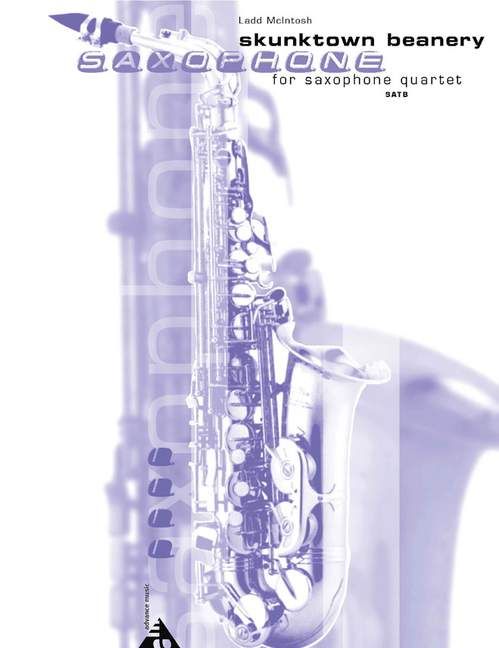
Ladd McIntosh
Skunktown Beanery
The Blastinoff Concerto No. 1 for Saxophone Quartet (SATB)
Ver
PDF
Ladd McIntosh
Skunktown Beanery
The Blastinoff Concerto No. 1 for Saxophone Quartet (SATB)
- Formación Cuarteto de saxofones (SATB)
- Compositor Ladd McIntosh
-
Dificultad
- Edición Partitura general y partichelas
- Editorial Advance Music
- Nº de pedido ADV07416
 en stock
disponible en 1-3 días laborables
IVA incluido.,
Más gastos de envío
No disponible en todos los países. Leer más

Descripción de la:
Skunktown Beanery is written for soprano, alto, tenor and baritone saxophones and begins with a jaunty rhythmic interplay with the baritone pitted against the three other voices. The interplay continues when the soprano breaks away (m. 23) to play an infectious melody which seems to float over the others. This culminates with the ensemble driving like a well-oiled big band (m. 39). There is a return to the soprano melody juxtaposed over the rhythmic interplay of the others (m. 56) which develops rhythmically, leading to an improvised jazz solo in the soprano.The solo is modal, visiting five different tonal areas until returning to the original D7#9. The other voices provide rhythmic and harmonic accompaniment throughout. After an improvised soprano cadenza (m. 139) there is a recapitulation section followed by a short coda (m. 196) to end the piece.This piece very much hinges on the soprano player's ability to improvise, as well as the baritone player's ability to play with great rhythmic accuracy and to be able to drive the ensemble in much the same way a bass player does a jazz ensemble.Skunktown Beanery is the first movement of 'The Blastinoff Concerto' for saxophone quartet. There are five movements in the 'Concerto' with several movements utilizing non-traditional combinations of saxophones.
Los clientes han valorado este artículo:
Información del Fabricante:
Advance Music
Weihergarten 5
55116
Mainz
Deutschland
Otros clientes también compraron:

Boots Randolph
- Cuarteto de saxofones (AATB)
- Partituras
- Larry Norred
-
disponible en 3-6 días laborables

Ennio Morricone
- Cuarteto de saxofones (SATB)
- Partitura general y partichelas
- Paolo Pavini
-
en stock
disponible en 1-3 días laborables