
Lorenzo Pusceddu
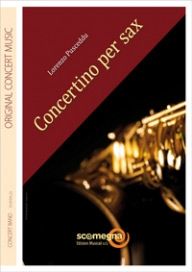
Concertino Per Sax
Solo Alto Sax (or Soprano Sax)
Ver
PDF
Lorenzo Pusceddu
Concertino Per Sax
Solo Alto Sax (or Soprano Sax)
- Formación Orquesta de viento (Solo/Feature: saxofón alto)
- Formación optativa Orquesta de viento (Solo/Feature: saxofón soprano)
- Compositor Lorenzo Pusceddu
-
Dificultad
- Edición Partitura general y partichelas
- Editorial Scomegna Edizioni Musicali
- Nº de pedido SCO1316
 disponible en 1-2 semanas
IVA incluido.,
Más gastos de envío
No disponible en todos los países. Leer más

Descripción de la:
This piece, dedicated to the Italian saxophonist Daniele Berdini, was premiered under the direction of the composer on 12 December 2015 by the dedicatee and the wind band Associazione Musicale 'Nazareno Gabrieli' Città di Tolentino at the Cathedral of Saint Nicola in Tolentino (Macerata).
The work, originally written for alto saxophone, can also be performed on soprano saxophone (another possibility is a performance, which alternates between both instruments).
The Concertino is articulated in the traditional three-movement form (Allegro - Andante - Allegro). The first movement, characterized by a light pace, alternates between 3/4, 6/8, and 2/4 meters and has in this rhythmic variety its principal feature. This movement should preferably be performed on the soprano saxophone.
The second movement introduces wide atmospheres and expressive themes and features a dense dialogue between soloist and orchestra.
The third movement, which follows the second without interruption, starts immediately with an extravagant character and a jaunty and rich musical language. A short solo cadence anticipates the resolute final coda.
The work, originally written for alto saxophone, can also be performed on soprano saxophone (another possibility is a performance, which alternates between both instruments).
The Concertino is articulated in the traditional three-movement form (Allegro - Andante - Allegro). The first movement, characterized by a light pace, alternates between 3/4, 6/8, and 2/4 meters and has in this rhythmic variety its principal feature. This movement should preferably be performed on the soprano saxophone.
The second movement introduces wide atmospheres and expressive themes and features a dense dialogue between soloist and orchestra.
The third movement, which follows the second without interruption, starts immediately with an extravagant character and a jaunty and rich musical language. A short solo cadence anticipates the resolute final coda.