
Alexander Glasunow
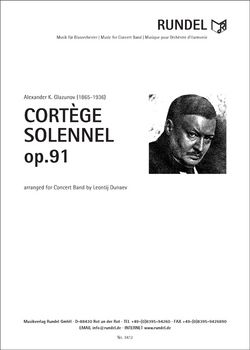
Cortege Solennel op.91
Escuchar
demo
Ver
vídeo
Ver
PDF
Alexander Glasunow
Cortege Solennel op.91
- Formación Orquesta de viento
- Compositor Alexander Glasunow
- Adaptador Leontij Dunaev
-
Dificultad
- Edición Partitura general y partichelas
- Editorial Musikverlag Rundel
- Nº de pedido MVSR3412
 disponible en 2-5 días laborables
IVA incluido.,
Más gastos de envío
No disponible en todos los países. Leer más

Descripción de la:
Alexander Konstantinovich Glazunov was born in 1865 and showed remarkable musical talent at a young age, which was also encouraged in particular by his teacher Nikolai Rimsky-Kosakov. He was accepted into the circle of composers around the music-loving entrepreneur and later music publisher Mitrofan Petrovich Belyayev, who published Glazunov's 1st Symphony and supported him for the rest of his life.
Glazunov revered composers such as Johannes Brahms and Pyotr Ilyich Tchaikovsky. In particular, the fusion of Russian music with Western European stylistic elements in Tchaikovsky's compositions noticeably influenced him in his own writing. He had an almost masterful command of classical compositional techniques and attached great importance to traditional musical forms. First as a teacher and from 1905 as director of the Petersburg Conservatory, Glazunov witnessed and taught a new generation of young composers. His students included, for example, Dmitri Shostakovich and Sergei Prokofiev. However, while this emerging generation was conquering the musical world with a new and sometimes experimental sound language, Glazunov remained within his own traditional musical framework.
'Cortège solennel op. 91' was written by Glazunov in 1910. The work is his third processional music and features a distinctively Russian sound language and traditional compositional techniques. After an opening fanfare, the Russian-influenced main theme is introduced. Glazunov subsequently processes this thematic material using a variety of techniques and allows it to wander through the instrumental groups before 'Cortège solennel op. 91' ends with a dramatic and large-scale conclusion. Leontij Dunaev has skillfully transferred Glasunov's musical signature to the wind orchestra and created an impressive arrangement.
Glazunov revered composers such as Johannes Brahms and Pyotr Ilyich Tchaikovsky. In particular, the fusion of Russian music with Western European stylistic elements in Tchaikovsky's compositions noticeably influenced him in his own writing. He had an almost masterful command of classical compositional techniques and attached great importance to traditional musical forms. First as a teacher and from 1905 as director of the Petersburg Conservatory, Glazunov witnessed and taught a new generation of young composers. His students included, for example, Dmitri Shostakovich and Sergei Prokofiev. However, while this emerging generation was conquering the musical world with a new and sometimes experimental sound language, Glazunov remained within his own traditional musical framework.
'Cortège solennel op. 91' was written by Glazunov in 1910. The work is his third processional music and features a distinctively Russian sound language and traditional compositional techniques. After an opening fanfare, the Russian-influenced main theme is introduced. Glazunov subsequently processes this thematic material using a variety of techniques and allows it to wander through the instrumental groups before 'Cortège solennel op. 91' ends with a dramatic and large-scale conclusion. Leontij Dunaev has skillfully transferred Glasunov's musical signature to the wind orchestra and created an impressive arrangement.