
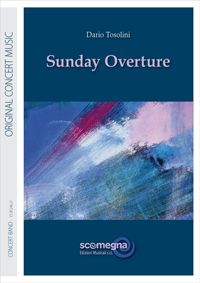
Dario Tosolini
Sunday Overture
Escuchar
demo
Ver
vídeo
Dario Tosolini
Sunday Overture
- Formación Orquesta de viento
- Compositor Dario Tosolini
-
Dificultad
- Edición Partitura general y partichelas
- Editorial Scomegna Edizioni Musicali
- Nº de pedido SCO1248
 disponible en 1-2 semanas
IVA incluido.,
Más gastos de envío
No disponible en todos los países. Leer más

Descripción de la:
Sunday Overture is music for a beautiful Sunday: sunny, cheerful and carefree.
From the very beginning (Moderato) it has a feeling similar to when, in the morning, one opens the windows and sunlight fills the room.
Then the music starts (Allegro) and seems to accompany children playing at the Park: at times energetic and sometimes humorous. Only once in a while the joyful atmosphere seems to darken, but the tension quickly melts to give way again to serenity.
The central section of the composition (Andante moderato) corresponds to the idyllic moment of this Overture: it is a dreamy episode that accompanies those who went to the Park with their beloved. The saxophones, resuming the rhythm that opens the Overture, lead this slow section with romantic and expressive solos.
Thereafter, the Allegro motive returns to bring back the carefree and joyful thoughtlessness of the children but, before the piece comes to an end, the lovers' theme reappears in an effective grandioso (Largamente).
A quick and energetic coda closes the entire composition.
From the very beginning (Moderato) it has a feeling similar to when, in the morning, one opens the windows and sunlight fills the room.
Then the music starts (Allegro) and seems to accompany children playing at the Park: at times energetic and sometimes humorous. Only once in a while the joyful atmosphere seems to darken, but the tension quickly melts to give way again to serenity.
The central section of the composition (Andante moderato) corresponds to the idyllic moment of this Overture: it is a dreamy episode that accompanies those who went to the Park with their beloved. The saxophones, resuming the rhythm that opens the Overture, lead this slow section with romantic and expressive solos.
Thereafter, the Allegro motive returns to bring back the carefree and joyful thoughtlessness of the children but, before the piece comes to an end, the lovers' theme reappears in an effective grandioso (Largamente).
A quick and energetic coda closes the entire composition.