
Ludwig van Beethoven
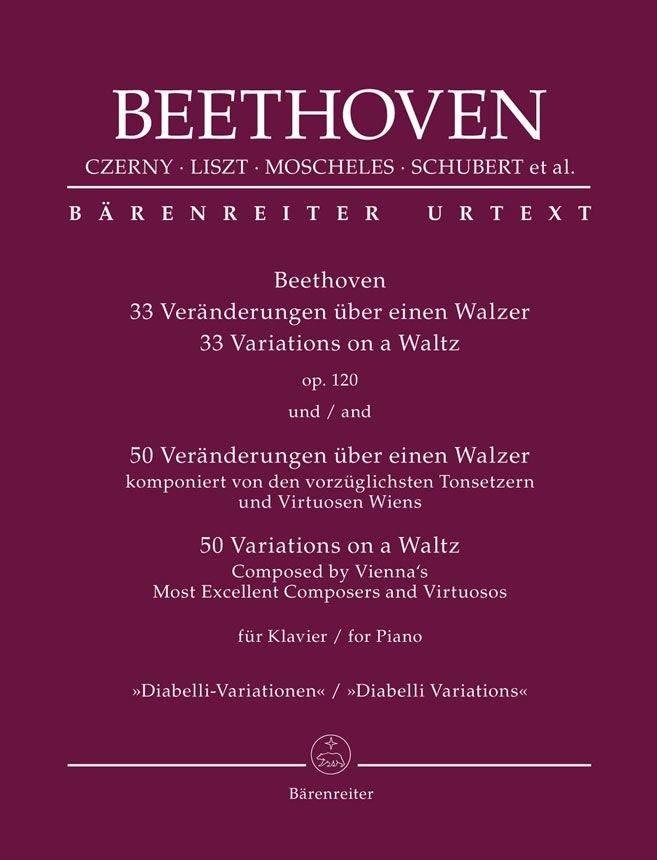
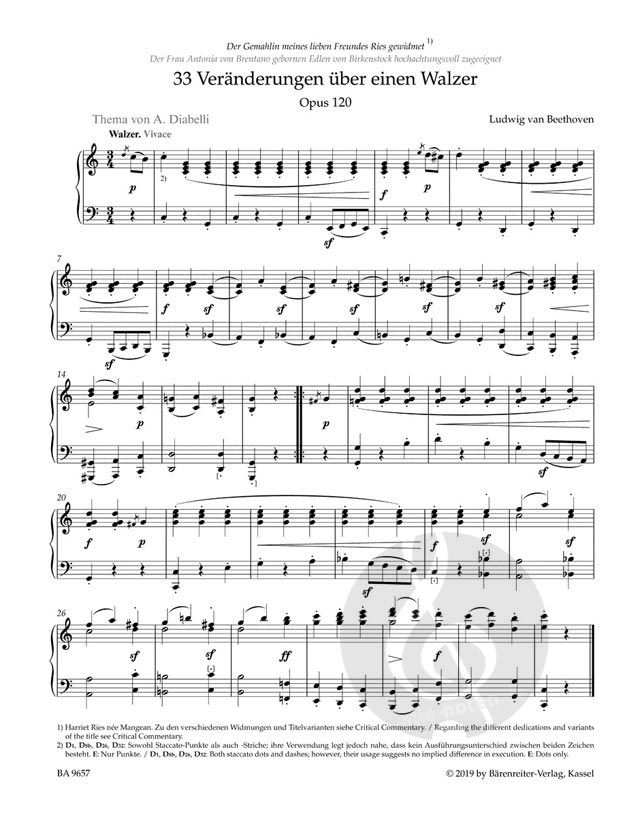
33 Variations on a Waltz op. 120 and 50 Variations on a Waltz
Diabelli Variations' - Composed by Vienna’s Most Excellent Composers and Virtuosos

Ludwig van Beethoven
33 Variations on a Waltz op. 120 and 50 Variations on a Waltz
Diabelli Variations' - Composed by Vienna’s Most Excellent Composers and Virtuosos
- Formación Piano
- Compositor Ludwig van Beethoven
- Serie Bärenreiter Urtext
- Editor Mario Aschauer
-
Dificultad
- Edición Partituras (Urtext)
- Editorial Bärenreiter Verlag
- Nº de pedido BA9656
 en stock
disponible en 1-3 días laborables
IVA incluido.,
Más gastos de envío
No disponible en todos los países. Leer más

Descripción de la:
Beethoven's 'Diabelli Variations', written between 1819 and 1823, mark the pinnacle of his oeuvre for variations and next to Bach's 'Goldberg Variations' form one of the most important contributions to this genre. In addition to Beethoven, 50 other composers from Austria, mainly Vienna, followed Diabelli's call to create variations for his famous waltz, among them Czerny, Moscheles, Fr. X. Mozart, Schubert, the 11-year-old Liszt and J. N. Hummel.
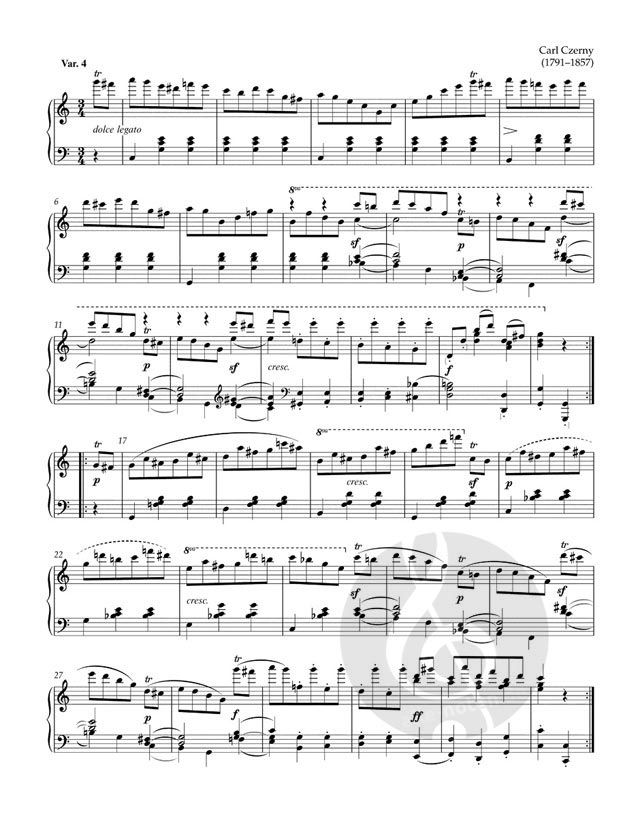
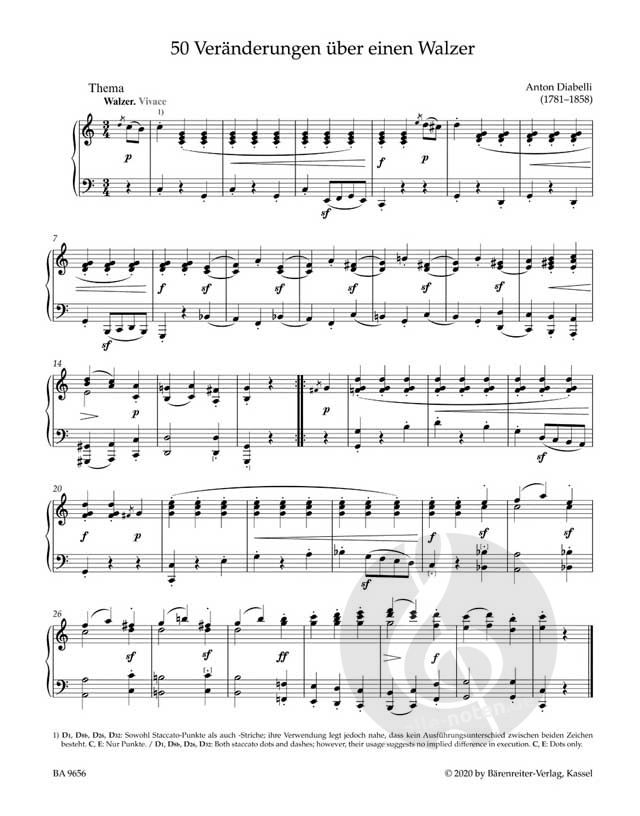
The variations first printed by Diabelli fictively as 'Fatherlandish Union of Artists Part I' (Beethoven's op. 120) and 'Part II' (the 50 variations of Vienna's 'most excellent composers and virtuosos') are presented here by Mario Aschauer for the first time in one edition. Furthermore the variations of Part II appear in an Urtext edition for the first time. The musical text is based on a meticulous study of the sources and for the first time relevant discrepancies between the main sources are presented in light grey print.
A detailed Critical Commentary (Eng) and notes regarding Viennese piano performance practice during Beethoven's day complete this special Urtext edition based on the most current research.
The variations first printed by Diabelli fictively as 'Fatherlandish Union of Artists Part I' (Beethoven's op. 120) and 'Part II' (the 50 variations of Vienna's 'most excellent composers and virtuosos') are presented here by Mario Aschauer for the first time in one edition. Furthermore the variations of Part II appear in an Urtext edition for the first time. The musical text is based on a meticulous study of the sources and for the first time relevant discrepancies between the main sources are presented in light grey print.
A detailed Critical Commentary (Eng) and notes regarding Viennese piano performance practice during Beethoven's day complete this special Urtext edition based on the most current research.
Los clientes han valorado este artículo:
Información del Fabricante:
Bärenreiter-Verlag Karl Vötterle GmbH & Co. KG
Heinrich-Schütz-Allee 35-37
34131
Kassel
Deutschland
Artículos relacionados:
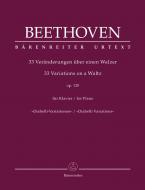
Ludwig van Beethoven
für Klavier - 'Diabelli-Variationen'
- Piano
- Partituras (Urtext)
- Bärenreiter Verlag
-
-
en stock
disponible en 1-3 días laborables - También disponible para descarga.

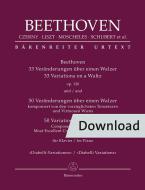
Ludwig van Beethoven
Variaciones Diabelli - compuestas por los más destacados compositores y virtuosos de Viena
- Piano
- Partituras de descargar (Urtext)
- Bärenreiter Verlag
-
Inmediatamente disponible
Descargar inmediatamente al finalizar la orden - Descarga instantánea
Otros clientes también compraron:
Béla Bartók
- Piano
- Partituras
-
disponible en 3-4 semanas
- Orquesta
- Partitura general de estudio
-
en stock
disponible en 1-3 días laborables
Franz Schubert
for Piano, Violin, Viola, Violoncello and Double Bass Trout Quintet
- Violín, viola, violonchelo, contrabajo y piano
- Partitura general de estudio
-
en stock
disponible en 1-3 días laborables
Georg Friedrich Händel
Oratorio en tres partes (versiones de 1739 y 1756/57)
- Solistas, 2 coros mixtos (SATB) y piano
- Reducción de piano
- Andreas Köhs
-
disponible en 2-4 días laborables
- También disponible para descarga.
- Orquesta
- Partitura general de estudio
-
en stock
disponible en 1-3 días laborables
Frédéric Chopin
- Piano
- Partituras (Urtext)
-
en stock
disponible en 1-3 días laborables
- Piano
- Partituras (Urtext)
-
en stock
disponible en 1-3 días laborables
Frédéric Chopin
- Piano
- Partituras (Urtext)
- Hans-Martin Theopold
-
en stock
disponible en 1-3 días laborables
Franz Liszt
- Piano
- Partituras
-
disponible en 3-6 días laborables
- Piano
- Partituras
- Franz Liszt
-
en stock
disponible en 1-3 días laborables - También disponible para descarga.

Jean-Philippe Rameau
- Piano
- Partituras
-
disponible en 3-6 días laborables
Frédéric Chopin
- Piano
- Partituras (Urtext)
-
en stock
disponible en 1-3 días laborables

Franz Liszt
- Piano
- Partituras
-
disponible en 3-6 días laborables
- Piano
- Partituras (Urtext)
-
en stock
disponible en 1-3 días laborables - También disponible para descarga.
- Orquesta
- Partitura general (Urtext)
-
disponible en 2-4 días laborables